5 Minute ReadSo, here’s the deal…
Hiring a social media agency is a lot like hiring a babysitter. Everyone says they're great with kids, but you won't really know until you get home and see what happened to the living room.
The problem isn't that agencies are hiding something. It's that most prospects ask the wrong questions. “How many posts do I get?” and “What does it cost?” matter, but they tell you almost nothing about whether your feed will actually look, sound, and perform like your brand six months from now.
Social isn't a nice-to-have anymore. It's the handshake before the deal, the place people check you out before they call, click, or walk through the door. So before you hand someone the keys, ask these five questions. A good agency will answer every one without flinching. A great one will back it up with receipts.
We've included our own answers along the way, because it felt rude to hand you a quiz and skip it ourselves.
1. Aesthetic
“How will you make my accounts look like us, and not like everyone else?”
Scroll any industry's feeds for five minutes and you'll see it: the same stock photo of a handshake, the same Canva template, the same "Happy Monday!" graphic. If you covered the logo, you couldn't tell whose page it was. That's the problem a real aesthetic solves.
What a good answer sounds like: The agency should describe a process, not a vibe. Listen for how they'll learn what makes your brand distinct, who decides the visual rules (color, type, photo style, tone of voice), and how those rules get documented so the look holds up month after month, not just in the first three posts.
Red flags: A portfolio where every client's feed looks the same. A plan built entirely on templates or stock. Anyone who says "we'll figure out the look as we go."
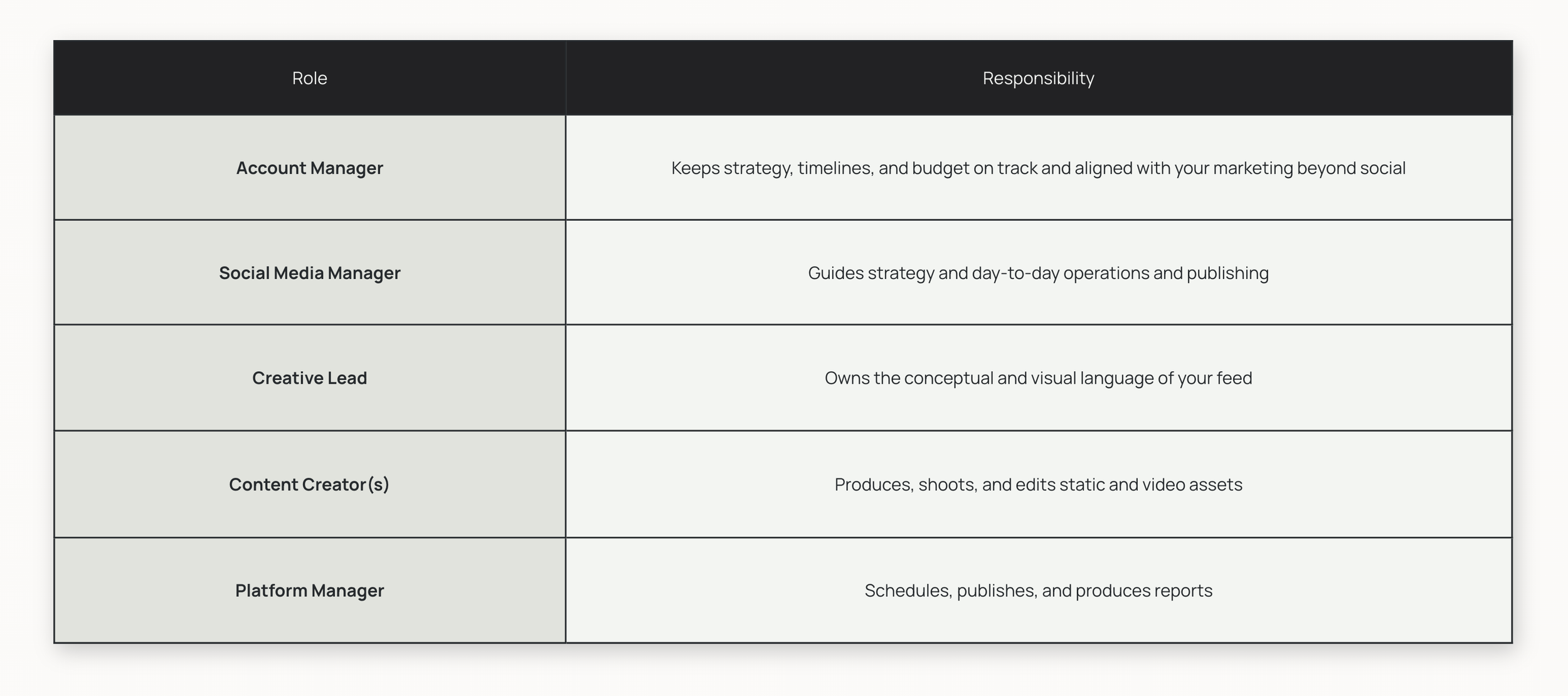
How we answer it: Every engagement starts with a Discovery Workshop where we dig into what makes your brand unique and who you're actually trying to reach. That becomes a Social Playbook that sets the strategic and creative rules for every platform you're on. A dedicated Creative Lead owns the conceptual and visual language of your feed, so there's one person accountable for it looking like you.
Then we go get real content. Our team typically spends one to two days a month on-site capturing photo and video of your actual people, places, and work. When a moment deserves more polish, Content Capsules bring in upgraded lighting, scripts, food stylists, or models.
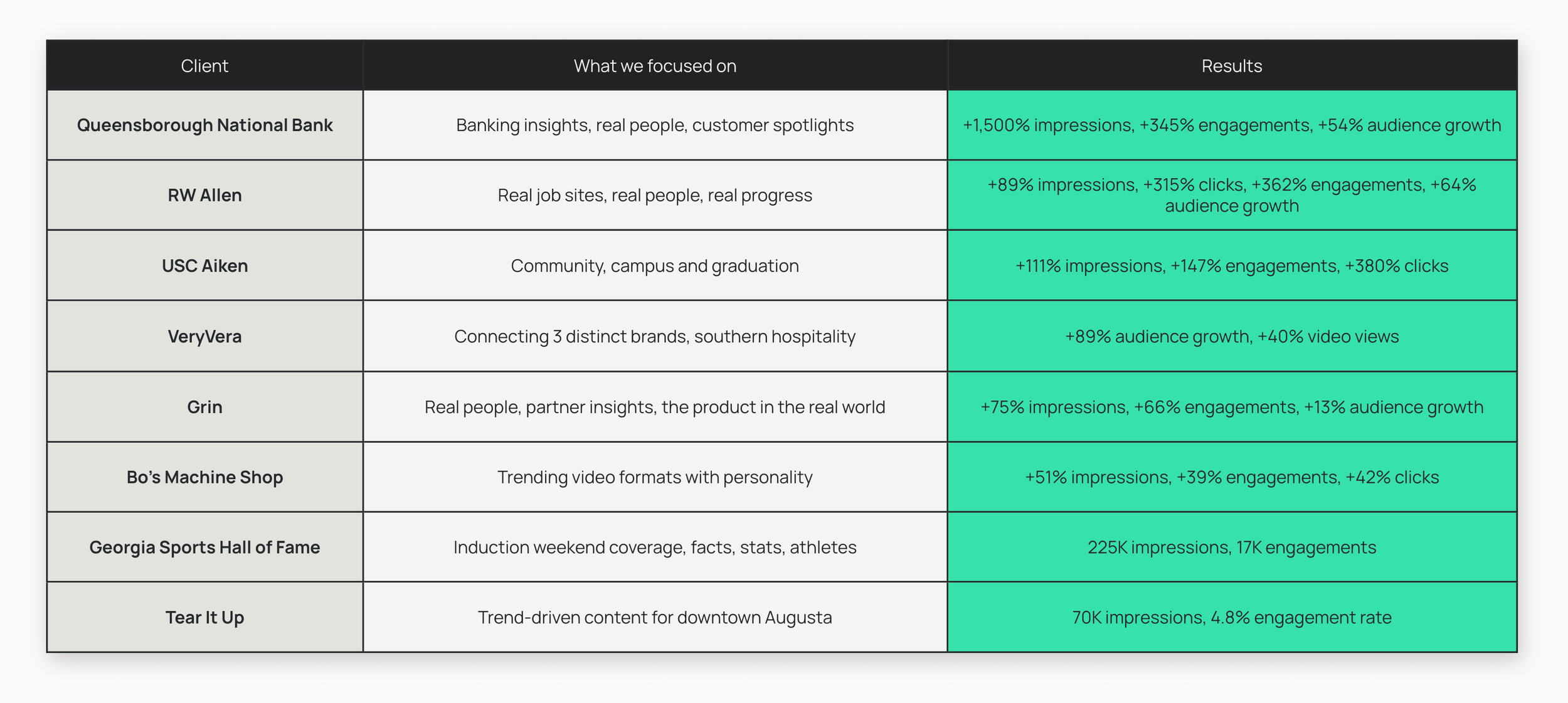
The proof is in how different our clients look from each other. RW Allen's feed is built from real job sites and real crews, and it grew its audience 64% and engagements 362%. Bo's Machine Shop leans into bold graphics, trending video formats, and the occasional flamethrower, earning a 51% lift in impressions, which translated into 23,741 new followers and 9.7 Million Video Views. Same agency, completely different brands. That's the point.
2. Strategy
“What's the plan for my industry, and how does it fit everything else we do?”
"Post consistently and use hashtags" is not a strategy. It's a horoscope. A real social strategy starts with your business goals and works backward to platforms, content, and cadence.
What a good answer sounds like: The agency should ask about your industry before they pitch you anything. Where does your audience actually spend time? What are competitors doing well, and where are they asleep at the wheel? Which platforms deserve your energy, and which ones can you politely ignore? Most importantly, how will social connect to your website, your ads, your email, and your brand as a whole?
Red flags: A one-size-fits-all package that puts every client on every platform. A team that can talk about posts but not about your business. Social that's treated as an island, disconnected from what the rest of your marketing is saying.
How we answer it: We're strategy first. The Workshop and Social Playbook decide which platforms you should be on (typically some mix of Instagram, Facebook, LinkedIn, or TikTok) and the strategic and creative approach for each. If you're not sure where you stand today, a stand-alone Social Audit examines your feed, deep dives into your competitors, and gives you data-backed recommendations.
Industry context changes everything. Banking can come off dry and clinical, so for Queensborough we built around local giveaways, customer spotlights, and practical money tips that showed off their energy. Impressions grew 1,500% and engagements 345%. For Tear It Up, the challenge was downtown construction scaring people away, so the strategy became trend-driven content proving downtown Augusta was still open and worth the trip. It delivered 70K impressions at a 4.8% engagement rate.
And because we're a full-service agency, social doesn't live on an island. Your Account Manager keeps your social strategy, timelines, and budget aligned with your marketing beyond social, from paid media and SEO to your website and video. Any agency can post for you. We'd rather build the brand behind it.
3. Reporting
“How will you measure success, specifically?”
Every agency promises "growth." Ask what kind, on which platform, from which content, and compared to what. If the answer is a screenshot of a follower count and a thumbs-up emoji, keep walking.
What a good answer sounds like: Success should be defined up front, tied to your goals, and broken down by platform and by content type. You should know which KPIs matter (impressions, engagements, clicks, audience growth, video views), how often you'll see them, and, critically, what the agency will change based on what the numbers say.
Red flags: Vanity metrics with no context. Reports that arrive as a 40-page data dump nobody explains. No baseline, so there's nothing to compare against. Reports that never lead to a different decision.
How we answer it: We align on KPIs in the first two weeks of onboarding, during discovery, so we're all keeping the same score. You get a performance report every month, and we walk through it with you: growth, top-performing content, engagement, and recommendations for what's next. After three months of publishing, we have enough data to start optimizing your accounts and creative approach in earnest, and that's when it makes sense to talk about putting paid dollars behind what's working.
4. Engagement
“Who's actually talking to our audience?”
Posting is a monologue. Social is supposed to be a conversation. Somebody has to answer the comment asking if you're open on Sunday, thank the customer who tagged you, and notice when a post is quietly turning into a complaint thread.
What a good answer sounds like: A clear owner for community management, with defined hours and response expectations. A plan for what the agency handles versus what gets routed to you (pricing questions, customer service issues, anything sensitive). And an approach to proactively building community, not just reacting to it, through collaborations, partner accounts, and content people want to share.
Red flags: "We'll keep an eye on it." No escalation plan for negative comments. Promises of 24/7 monitoring at a price that makes the math impossible. (Somebody is either not sleeping or not monitoring.)
How we answer it: We're upfront about scope. Our Growth tier includes lite community management and engagement (not 24/7), and higher-touch coverage can be built into a custom scope. During onboarding we agree on who responds to what, so your customers get the right answer from the right person.
We also go looking for community. For the Georgia Sports Hall of Fame's Induction Weekend, we collaborated with accounts like the Atlanta Falcons, Georgia Tech, and UGA Women's Tennis to extend reach well beyond the Hall's own followers, producing 225K impressions and 17K engagements. For USC Aiken, spotlighting graduates and families turned followers into amplifiers who shared the content themselves. That's engagement doing what it's supposed to do.
5. Logistics
“How does this actually work, and what do you need from me?”
The best-looking strategy deck in the world won't save you from a missed holiday post or a password nobody can find. Logistics are where good intentions go to die, so ask about them before you sign.
What a good answer sounds like: A named team with clear roles. A predictable monthly rhythm for planning, approvals, and publishing. A clear position that you own your accounts and the agency keeps them healthy. And an honest list of what they need from you, because great social, like most of our favorite posts, is a collaboration.
Red flags: One person doing everything with no backup. Content that shows up for approval the day before it posts. An agency that owns your accounts or your logins. A vague onboarding that gets "started" for three months.
How we answer it: Here's who's on your account (team members may wear more than one hat):
Why hire a full-service firm to run your social?
Most social media companies are built to do one thing: post. That works fine right up until your brand outgrows the feed, which, if social is doing its job, it will. Suddenly you need a launch video, a new website, ads that actually convert, or a brand identity that matches the company you've become. Now you're interviewing agencies all over again, re-explaining who you are, and hoping the new folks play nicely with the old ones.
We are built for what comes next. We're a full-service strategy and creative agency, which means the team running your social is sitting down the hall from the people who can take your brand anywhere else it needs to go.
Click the button up there to get our full capabilities deck or skip the reading and schedule a conversation with me. I promise not to show up with a stock photo of a handshake.