Pitch, Please
8 Minute Read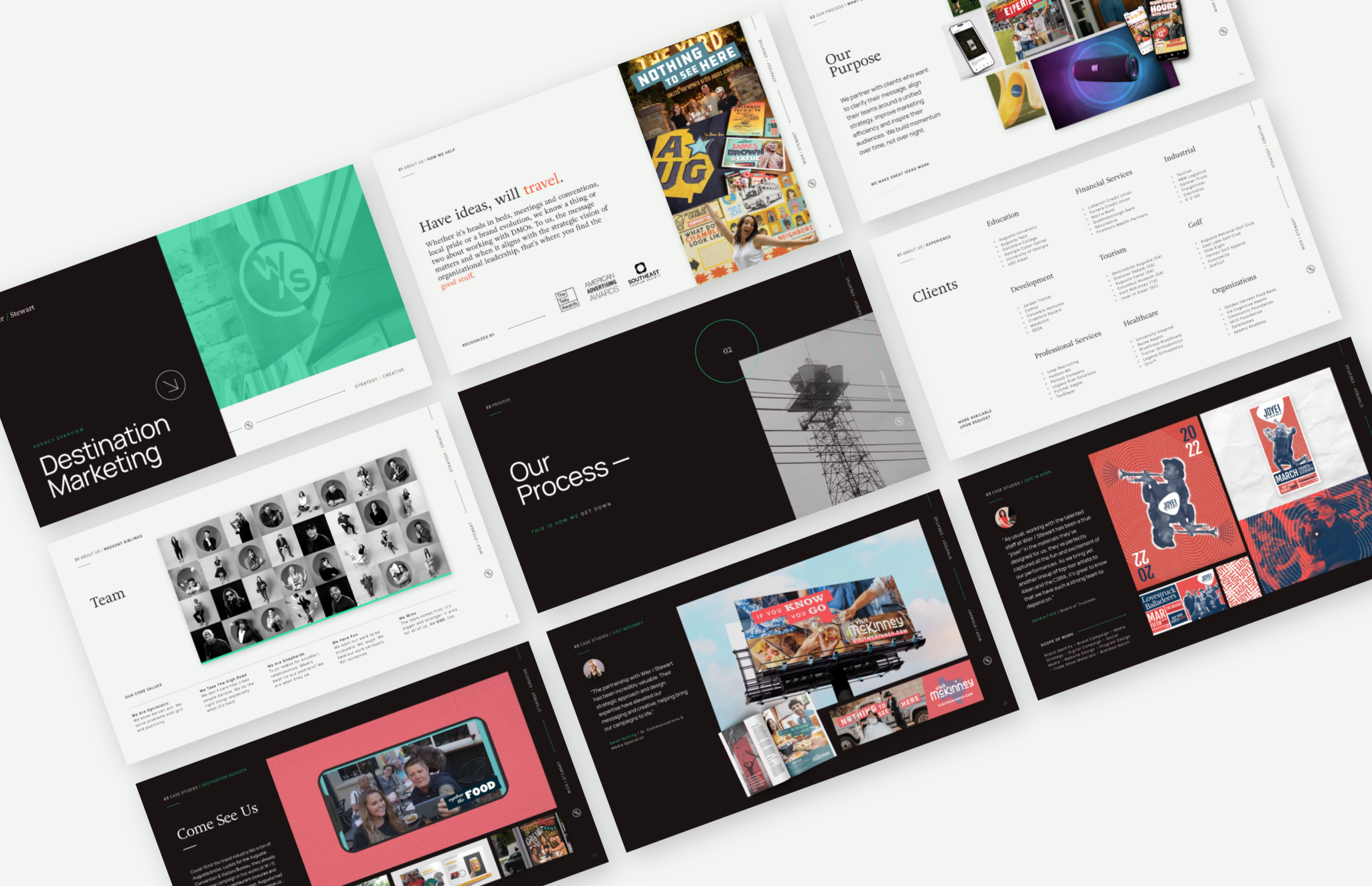

“I’ve probably written 500+ pitches in my career.
That sounds impressive until you realize I’ve also lost roughly 350 of them. Welcome to advertising.”
Daniel Stewart, President & Director of Partnerships
At Wier / Stewart, our win rate hovers around 30%, which—depending on how optimistic you are—is either “pretty solid for an agency” or “proof I should’ve learned accounting instead.”
But after years of proposals, presentations, awkward follow-up emails, panic pricing exercises, and watching clients ghost harder than a middle school crush, I’ve learned a few things about pitching creative work.
Most of them the hard way.
Your Pitch Is Your Brand
A lot of companies obsess over the customer-facing stuff:
the website
the ad campaign
the social content
the trade show booth
the swag nobody actually wears (shoulda used Showpony)
Meanwhile, their proposal looks like it was assembled during a hostage situation in Microsoft Word.
Your pitch is literally the first real deliverable a prospect sees from you. If it’s sloppy, generic, or ugly, you’re unintentionally telling them, “Don’t worry, the actual work will probably also feel rushed and uninspired.”
In our business, pitches have to be beautiful. Period.
Honestly, this applies to almost every industry. If you’re asking someone to trust you with serious money, the presentation of your thinking matters. People absolutely judge books by their covers.
And they judge agencies by their PDFs.
The Budget Problem Nobody Talks About
Here’s the fun part about agency pitching:
Most of the time, clients won’t tell you the budget.
So you’re expected to:
solve the problem,
build a strategy,
scope the work,
estimate timelines,
and somehow magically land on a price point that doesn’t scare them into cardiac arrest.
Easy.
When we don’t know the budget, we usually frame things one of two ways:
First, we’ll recommend an appropriate marketing investment relative to the company’s revenue and growth goals.
Or second—and this tends to resonate more—we explain that hiring us as a full-service agency financially feels a lot like adding 1–3 senior-level employees internally. Except instead of a few hires, you get a team of strategists, creatives, designers, writers, developers, and marketers working on your business.
That comparison helps clients contextualize value instead of just staring at a number and sweating.
The Goldilocks Rule
Most pitches are either:
too short,
too long,
or somehow both.
If you’re selling a high-ticket service, you have to clearly communicate value without writing a novel. Clients do not read every word. I know this because I use proposal software that tells me when they open the deck and how long they spend on each page.
Some of y’all are making $80,000 decisions reading slide 14 for nine seconds. God bless.
The goal is clarity, not volume. Too little information makes you look careless. Too much information makes you look desperate.
You want the proposal to feel like: “Wow, these people really thought this through.”
Not: “These people have copied and pasted the same service list since 2017.”
What Actually Needs To Be In A Good Pitch
A strong proposal usually covers a few core things really well:
About You
How do you work?
Why are you different?
Why should they trust you?
This is where personality matters. Nobody wants to hire a robot agency full of “innovative synergistic solutions.”
__
About the Project
This section should feel custom-built for the client’s actual problem or opportunity.
If your proposal could be sent to five different companies unchanged, it’s probably too generic.
__
Scope
Explain the recommended approach clearly.
Not every microscopic deliverable.
Just the path.
Clients want confidence, not homework.
__
Price
Tie fees directly to outcomes whenever possible.
And for the love of all things holy, present pricing cleanly.
__
Timeline
How long will this take?
What happens first?
What happens after launch?
Simple.
__
Proof
Case studies.
Examples.
Results.
You can say you’re great all day long. Proof is what closes deals.
__
FAQ
This is massively underrated.
Answer the questions they’re already thinking:
Why does this cost this much?
What if timelines shift?
What happens after launch?
How involved do we need to be?
Every question you answer upfront removes friction from the buying decision.
Simplify Everything
Clients do not want complexity. They want confidence and they want clarity. They want to feel like saying yes will make their lives easier. A lot of agencies accidentally pitch process instead of outcomes. Clients don’t REALLY care about your twelve-step proprietary discovery matrix. They care about whether you can solve the problem without setting their organization on fire.
Simplify wherever possible.
Speed Kills
You don’t need to send a proposal 15 minutes after the intro Zoom call. That usually just tells the client you already had the deck made before the meeting started.
But, you should move quickly. At our agency, we try to get thoughtful pitches out the same week while the conversation is still fresh. Fast follow-up communicates professionalism, urgency, and attentiveness. It also quietly sets expectations for responsiveness moving forward.
And here’s the truth: By the time most companies contact you, they’re already close to hiring someone.
(Unless they’re window shopping. Which absolutely happens. Trust your instincts.)
Use a CRM Like an Adult
Please use a CRM. I’m begging you. Even if it’s just to track proposals and see when they’re opened. Knowing whether a client has viewed your proposal once versus twelve times is incredibly useful information.
If they haven’t opened it? You probably need to follow up.
If they’ve opened it eight times and shared it internally? Congratulations. People are fighting about your pricing in a conference room somewhere.
Hide an Inside Joke in the Pitch
This is one of my favorite tricks. During the first meeting, there’s almost always some random personal anecdote, joke, or conversational moment you can subtly reference later in the proposal.
Maybe somebody mentioned golf. Maybe their dog barked during the Zoom. Maybe the CFO was wearing a ridiculous fishing shirt.
Work it in naturally. Not because you’re trying to be clever. Because it communicates something important:
“We listened.”
And honestly? That matters more than people think.
No News Usually Isn’t Good News
In my experience, most wins happen quickly. Usually within two weeks. If a proposal disappears into the abyss with no meaningful engagement, something is probably off.
And most of the time? It’s pricing. Not always. But usually.
Clients who are excited move fast. Clients who vanish are often trying to figure out how to say:
“We loved this but absolutely cannot afford it.”
A pitch is not paperwork.
It’s positioning.
It’s strategy.
It’s psychology.
It’s design.
It’s storytelling.
It’s sales.
It’s your first impression.
And whether people realize it or not, they’re evaluating what it feels like to work with you long before they sign anything.
Final Thought: